

Understanding the Last Sermon of Prophet Muhammad (PBUH)
The Last Sermon of Prophet Muhammad (peace be upon him) is one of the most powerful and meaningful speeches in human history. Delivered over 1400 years ago, its message remains relevant today. It is not just a religious speech; it is a universal charter of human rights, social justice, equality, and moral responsibility.
The sermon summarizes the core teachings of Islam and serves as a final reminder from the Prophet (PBUH) to humanity. It addresses issues such as the dignity of human life, women’s rights, racial equality, economic justice, and accountability before God. For Muslims, it is a guiding framework for personal character and social conduct.
This article explores the background of the sermon, the circumstances in which it was delivered, its key themes, its historical importance, and its continued relevance in modern life.
Historical Background
The Last Sermon was delivered during the Prophet Muhammad’s (PBUH) farewell pilgrimage, known as Hajjat-ul-Wida, in the year 10 AH (632 CE). By this time, Islam had spread across much of the Arabian Peninsula. The Muslim community was strong and united, and the Prophet (PBUH) knew that his mission was nearing completion.
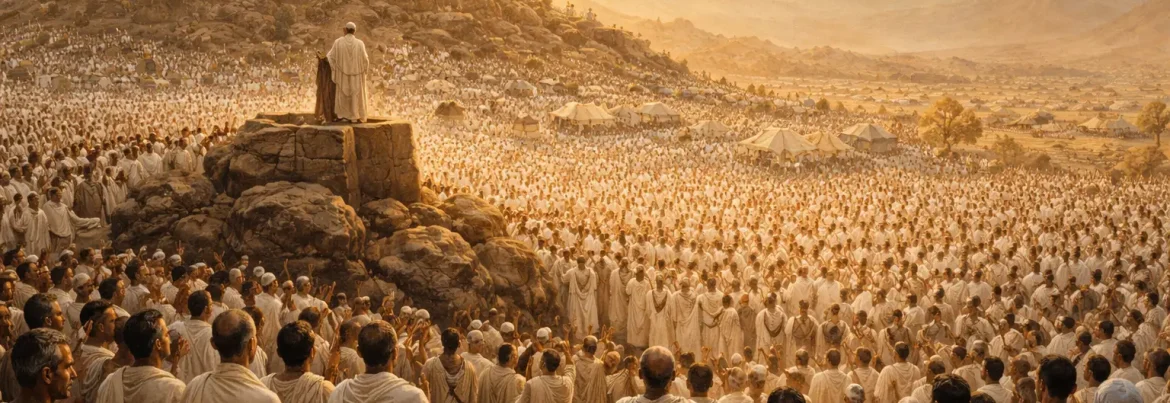
More than 100,000 Muslims gathered in the plains of Arafat near Makkah to perform Hajj with the Prophet. It was a historic moment: people from different tribes, races, and social classes stood together in worship. The Prophet addressed them from Mount Arafat on the 9th of Dhul Hijjah.
This was not an ordinary sermon. It was a farewell message — a final set of instructions meant to guide humanity after his passing. Shortly after this pilgrimage, the Prophet (PBUH) returned to Madinah and passed away a few months later.
The Purpose of the Final Sermon
The sermon served several purposes:
-
To summarize the essential principles of Islam
-
To establish social and moral justice
-
To remove pre-Islamic tribal practices
-
To affirm human equality
-
To remind people of accountability before Allah
-
To strengthen unity among Muslims
It was a message not just for the audience present at Arafat, but for all future generations.
Core Themes of the Last Sermon
1. Sanctity of Life, Property, and Honor
The Prophet (PBUH) declared that a person’s life, wealth, and honor are sacred. Harming another person unjustly is a serious sin. He compared the sacredness of human life to the sacredness of the day of Arafat and the holy city of Makkah.
This message established a clear foundation: human dignity must be protected at all costs. Violence, oppression, and exploitation are forbidden.
2. End of Tribal Revenge and Blood Feuds
Before Islam, Arab society was filled with cycles of revenge. One murder could lead to generations of tribal warfare. The Prophet abolished these practices and declared all previous blood claims canceled.
This was a revolutionary step toward social peace. Justice was to replace revenge. Islam emphasized forgiveness, fairness, and lawful accountability rather than emotional retaliation.
3. Economic Justice and the Abolition of Usury
The sermon strongly condemned riba (interest/usury). The Prophet announced that all forms of interest from the pre-Islamic period were abolished. Exploiting the poor through unfair financial practices was declared unjust.
This established an economic principle of fairness. Wealth should circulate in society without oppression. Islam promotes trade, charity, and ethical financial dealings instead of exploitation.
4. Rights and Responsibilities of Women
One of the most important parts of the sermon concerns women’s rights. The Prophet (PBUH) reminded men to treat women with kindness and respect. He emphasized that women have rights over men just as men have rights over women.
In a time when women were often treated as property, this message was groundbreaking. Islam elevated the status of women, granting them dignity, inheritance rights, and protection.
The sermon stresses mutual respect, compassion, and responsibility within marriage.
5. Equality of All Humanity
Perhaps the most famous line of the Last Sermon is the declaration that no Arab is superior to a non-Arab, and no white person is superior to a black person — except in righteousness and good character.
This statement eliminated racial and tribal superiority. It established a universal principle: all humans are equal before Allah.
In a world still struggling with racism and discrimination, this message remains deeply relevant.
Preserving the Message Through Learning
The Prophet (PBUH) ended his sermon by urging those present to convey his message to those absent. This instruction highlights the importance of preserving and teaching Islamic knowledge.
Today, learning the Quran and understanding the teachings of the Prophet is a responsibility shared by every Muslim family. Online Quran education has made it easier than ever for children and adults to connect with authentic Islamic learning. Through structured Quran classes, students can learn recitation, Tajweed, and the meanings behind the Prophet’s teachings — including timeless messages like the Last Sermon.
Access to qualified teachers, regular lessons, and one-on-one attention ensures that the message of Islam is passed down correctly, just as the Prophet intended.
Accountability Before Allah
The Prophet reminded the people that they would one day return to Allah and be judged for their deeds. No injustice would go unnoticed. Every action — big or small — carries consequences.
This reminder encourages moral responsibility. A believer is aware that worldly power, wealth, and status are temporary, but accountability is eternal.
Unity of the Muslim Ummah
The sermon stressed unity and brotherhood among Muslims. The Prophet warned against returning to division and conflict after his death. He reminded the community that all believers are brothers and sisters.
This unity was not based on tribe, nationality, or language — but on shared faith and moral values.
The Completion of the Religion
During the farewell pilgrimage, the Quranic verse was revealed:
“Today I have perfected your religion for you, completed My favor upon you, and chosen Islam as your religion.”
This verse signaled that the message of Islam had reached completion. The Last Sermon serves as a summary of this perfected guidance.
The Last Sermon as a Universal Human Rights Charter
Modern scholars often describe the Last Sermon as one of the earliest declarations of human rights. It contains principles that align with contemporary ideas of justice:
-
Protection of life and property
-
Gender dignity and responsibility
-
Economic fairness
-
Racial equality
-
Social accountability
-
Moral governance
These principles were articulated centuries before modern human rights documents.
Relevance in the Modern World
Despite being delivered in the 7th century, the sermon addresses many modern problems:
-
Racism and discrimination
-
Gender injustice
-
Economic exploitation
-
Violence and revenge culture
-
Social division
-
Moral decline
The Prophet’s guidance offers solutions rooted in compassion, fairness, and spiritual awareness.
The sermon teaches that true progress is not only technological or economic — it is moral and ethical.
Lessons We Can Apply Today
The Last Sermon is not only history; it is a living guide. Some practical lessons include:
-
Respect every human being
-
Avoid injustice in personal and financial dealings
-
Treat women with dignity
-
Reject racism and prejudice
-
Strengthen unity in families and communities
-
Live with awareness of accountability before Allah
-
Seek knowledge and pass it on
These lessons shape both individual character and social harmony.
Conclusion
The Last Sermon of Prophet Muhammad (PBUH) is a timeless message for humanity. It is a farewell speech that became a permanent constitution of ethics and justice. It summarizes the heart of Islam: mercy, equality, responsibility, and devotion to Allah.
More than 1400 years later, its words continue to guide millions of people. The sermon reminds us that faith is not only about worship — it is about how we treat others, how we conduct our lives, and how we build a just society.
Understanding and teaching this message is part of preserving the Prophet’s legacy. By learning the Quran and studying his teachings, we keep his guidance alive for future generations.
